Updated Iowa letter on Medica’s substandard & discriminatory HIV medication plan design and coverage
Commissioner
Iowa Insurance Division
1963 Bell Avenue, Suite 100
Des Moines IA 50315
Dear Commissioner Ommen:
In November 2024, the HIV+Hepatitis Policy Institute submitted a complaint regarding substandard, discriminatory coverage of HIV treatment medications by Medica health plans in Iowa. After an unfavorable response from the Division, we wrote a second letter with additional data and formulary analysis to demonstrate Medica’s benefit designs were indeed discriminatory, as well as an extreme outlier among issuers on the Iowa Marketplace. We were pleased to learn after our second letter that the Division seemed to concur with our assessment and would require Medica to improve the coverage and tiering of antiretrovirals in the 2026 plan year.
Now that formularies for the 2026 plan year are available, we are pleased to note substantial improvements in Medica’s coverage and trust that our complaints in Iowa and Minnesota and your work with Medica played a major role in these improvements.
Despite these improvements, our analysis demonstrates that substantial issues remain with Medica’s coverage and tiering of HIV medications. We maintain that Medica’s improved benefit designs still discourage enrollment by people with HIV, in violation of the non-discrimination provisions of the ACA by (1) not meeting clinical appropriateness standards and (2) engaging in adverse tiering.[1] At this time, we are submitting additional data comparing Medica’s benefit designs with those of other issuers on the Iowa Marketplace to show that Medica remains an outlier.
(1) Clinical appropriateness.
Complaint: Medica’s plans fail to cover treatment regimens recommended in broadly accepted treatment guidelines and that are indicative of clinical best practice.
Plans must cover drugs recommended in broadly accepted treatment guidelines and reflect clinical best practice, and so should cover all “preferred” and “alternative” first-line regimens as well as other guideline-recommended drugs.
There is no question that Medica’s coverage of HIV treatment has improved substantially in the 2026 plan year. It now covers five out of eight recommended “preferred” and “alternative” first-line treatment regimens, up from three in the 2025 plan year. It has dramatically improved coverage of single-tablet regimens (STRs), covering ten out of twelve in 2026, where it only covered three in 2025. The total number of antiretroviral medications covered has also improved, from 31 out of 53 in 2025 to 34 in 2026.
But the table below shows that Medica remains an outlier in coverage of HIV treatment. Every other issuer covers a significantly higher number of antiretrovirals (ARVs) than Medica. All but one issuer (United Healthcare of the River Valley, available in only a handful of counties) cover a greater number of first-line regimens. Only with respect to coverage of single-tablet regimens (STRs) do we find Medica providing coverage that is not substantially below its peers:
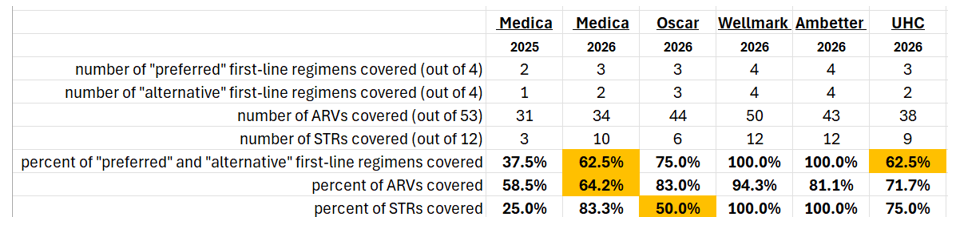
We believe this data demonstrates that Medica has some way to go before it can be deemed to provide clinically appropriate coverage of recommended HIV treatment medications such that it does not discourage enrollment by people with HIV.
(2) Adverse tiering.
Complaint: Medica’s plans engage in a practice known as “adverse tiering,” in which all or the majority of drugs to treat a particular health condition are placed on the highest cost-sharing tiers.
Adverse tiering has been clearly and consistently defined by CMS since 2015: it occurs when an issuer places all or a majority of drugs to treat a particular health condition on a high-cost formulary tier.[2] There can be no doubt that most of Medica’s plans on the Iowa Exchange violated this straightforward standard in 2025, when it placed 26 (83.9%) of the 31 ARVs it covered on tier 5, (the specialty tier), with only 5 on a low-cost tier.
For the 2026 plan year, Medica has placed 24 (70.6%) of the 34 covered ARVs on tier 5, with 5 ARVs on Tier 4 (non-preferred drugs) and 5 on low-cost tiers, showing that Medica continues to place a majority of HIV treatment drugs on the highest cost-sharing tier despite the tiering changes in the new plan year.
Comparing Medica’s tiering of ARVs to that of other issuers on the Exchange, while improved, we note that Medica continues to place a far higher share of ARVs on the highest-cost tier than any other issuer:

Since Medica made significant changes to ARV tiering in its 2026 formulary, and since this new formulary passed the QHP review process after the Division received our complaint, we compared the tiering of two important subsets of ARVs: STRs and recommended “preferred” and “alternative” first-line regimens.
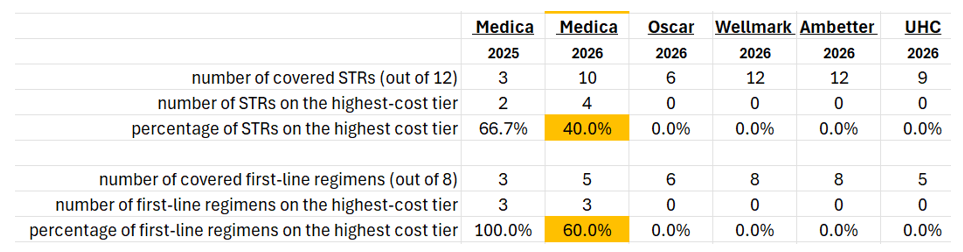
Here we find that Medica tiering of these two important groups of ARVs once again is sharply divergent from the other three issuers, none of which place a single STR or first-line regimen on the highest-cost tier.
We note that Medica has placed five STRs that were not covered on its 2025 formulary on the second highest-cost tier, tier 4 (Odefsey, Triumeq, Complera, Genvoya, and Stribild), suggesting that Medica may have focused its pattern of improvements in tiering exclusively on STRs, and ignored the many important treatment regimens available only as combinations of other medications.
We find that there are other examples of discriminatory tiering of HIV treatments by Medica as well as other issuers:
- Medica offers many plans in which tier 4 is associated with 50% coinsurance while tier 5 is associated with 60% coinsurance. While there is a difference between these two tiers, we believe covering all antiretrovirals on two very high-cost coinsurance tiers still constitutes adverse tiering. [3]
- Several issuers on the Iowa Exchange offer plans which charge a low copay for generics, but 50% coinsurance for all medications on the preferred, non-preferred, and specialty tiers.[4] We believe all of these plans engage in adverse tiering since they place all ARVs, STRs, and first-line regimens on tiers that result in high cost-sharing.
Though the pattern of improvement in Medica’s coverage and tiering in 2026 plans is welcome, we believe the data we have presented demonstrate that Medica is continuing to provide discriminatory and substandard coverage of HIV treatment medications in ways which discourage the enrollment of people living with HIV. In addition, they show that Medica’s practices are an outlier on the Iowa Exchange with respect to both adverse tiering and clinical appropriateness.
Formularies that discriminate against people living with HIV should not happen in the first place and should not have to be corrected through complaints. Despite these improvements we ask you to enforce the law and examine the continuing problems with Medica and other issuers so that all 2026 Marketplace and other state-regulated plans in Iowa meet ACA requirements for non-discriminatory coverage of HIV treatment.
If you have any questions, comments, or would like to discuss these issues further, please contact Carl Schmid, Executive Director, HIV+Hepatitis Policy Institute at cschmid@hivhep.org or (202) 462-3042, or Kevin Herwig, Health Policy Manager, HIV+Hepatitis Policy Institute at kherwig@hivhep.org or (617) 666-6634.
Sincerely,

Carl E. Schmid, II
Executive Director
cc: Peter Nelson, Director, CCIIO
Jeff Wu, Deputy Director for Policy, CCIIO
Paula M. Stannard, Director, HHS Office for Civil Rights
Heather Hauck, Associate Administrator, HIV/AIDS Bureau, HRSA
[1] 45 CFR 156.122 (a)(3)(iii)(H).
[2] See, for example, the 2016 Payment Notice Final Rule (80 FR 10822): https://www.federalregister.gov/documents/2015/02/27/2015-03751/patient-protection-and-affordable-care-act-hhs-notice-of-benefit-and-payment-parameters-for-2016.
[3] For example, Medica with CHI Health Gold $0 Copay PCP Visits + Adult Eye Exam, Medica Insure Silver $0 Copay PCP Visits, and Elevate by Medica Bronze Share.
[4] For example, Oscar Bronze Classic 4700 or Wellmark Bronze Traditional HMO.